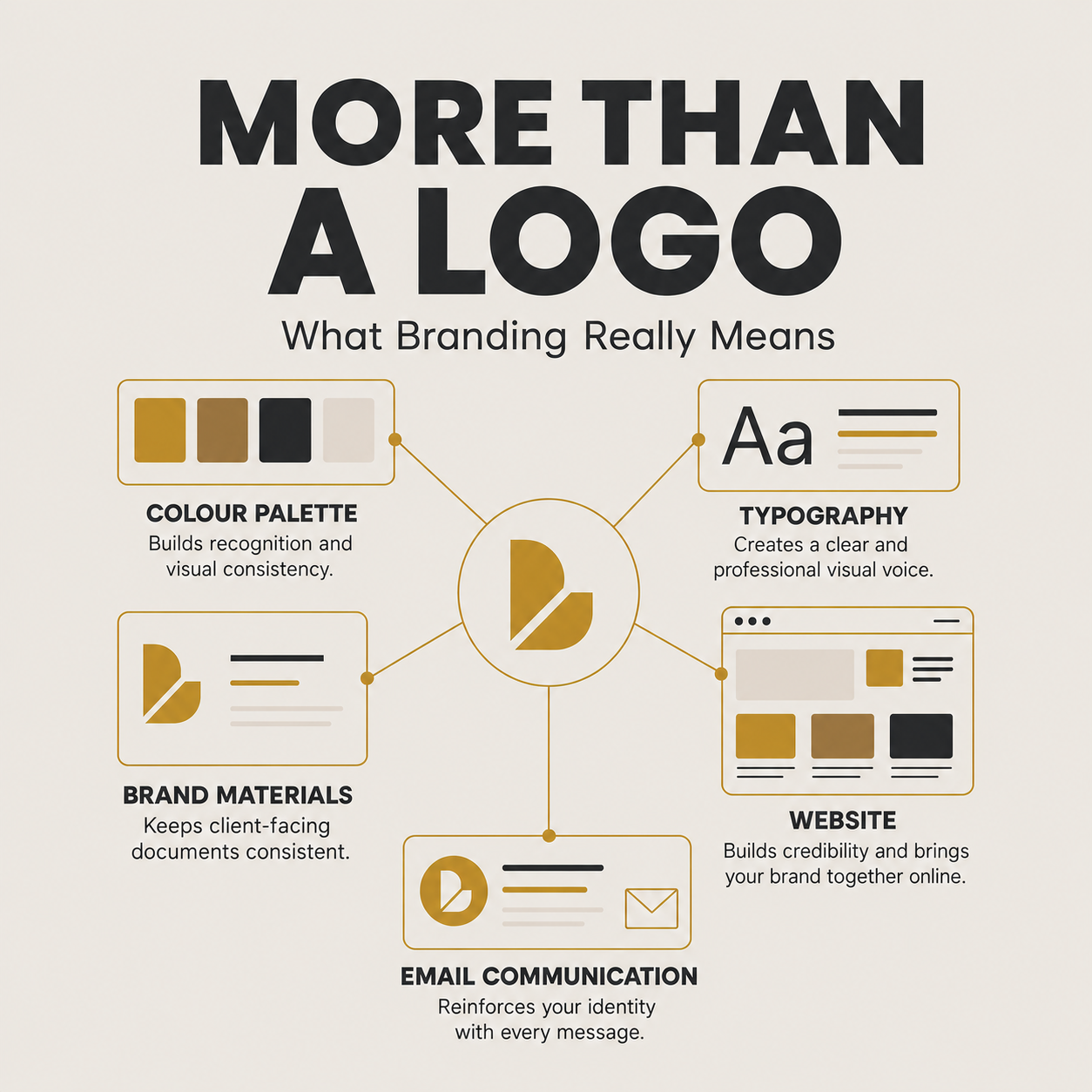
When people hear the word “branding,” they often think of a logo.
A professional logo is certainly an important part of a brand—but is a logo enough to build a strong and recognisable business?
The simple answer is no.
Your logo is one visual representation of your business. Your brand is the complete impression people form whenever they see, hear about or interact with your business.
It includes how your business looks, what it communicates, how it treats clients and whether its different touchpoints feel professional and consistent.
What Does Branding Really Mean?
Branding is the process of shaping how people recognise, understand and remember your business.
It combines several elements, including:
- Your business name and logo
- Your colours, fonts and visual style
- The language and tone you use
- The services you are known for
- The values your business represents
- The experience you provide to clients
- The promises and expectations associated with your business
- The reputation you build over time
Your logo helps people identify your business, but your brand tells them what your business stands for and why they should choose it.
For example, two businesses may offer exactly the same service, but potential clients may perceive them very differently. One may appear professional, organised and trustworthy, while the other may seem unclear or inconsistent.
That difference is often the result of branding.
Branding Creates a Clear Business Identity
Good branding helps your business communicate who it is, what it offers and who it serves.
When these elements are unclear, potential clients may struggle to understand whether the business is suitable for them. They may visit the website, view a social media profile or receive a proposal and still be uncertain about the business’s main area of expertise.
A clear brand identity helps answer important questions such as:
- What does this business do?
- Who does it help?
- What makes it different?
- What can clients expect?
- Why should people trust it?
This is particularly important for legal professionals and service-based businesses, where clients are not buying a physical product they can examine beforehand. They are choosing a person or business based largely on credibility, expertise and trust.
Consistency Builds Recognition
Strong brands are consistent.
This does not mean repeating exactly the same message everywhere. It means presenting the business in a way that feels connected and recognisable across every platform and client interaction.
Your website, Google Business Profile, LinkedIn presence, email communication, quotations, social media graphics and printed materials should all appear to belong to the same business.
Consistency may include using the same:
- Logo and brand colours
- Fonts and graphic style
- Business description
- Contact information
- Tone of communication
- Key messages
- Areas of specialisation
When people repeatedly see a consistent identity, they begin to recognise and remember the business more easily.
Inconsistent branding can have the opposite effect. Different logos, outdated contact details, conflicting service descriptions or poor-quality graphics can create uncertainty and make the business appear less established.
Professional Branding Builds Trust
Before contacting a business, potential clients often look for signs that it is credible.
They may visit its website, search for it on Google, review its LinkedIn profile or look at its recent content. Each of these interactions contributes to their overall impression.
Professional branding shows that the business has taken the time to present itself clearly and thoughtfully. It suggests care, organisation and attention to detail.
This does not mean that every business needs an expensive or complicated brand identity. A small business can build a strong brand by using a simple, professional visual style and communicating consistently.
The most important requirement is that the branding reflects the quality and professionalism of the service being offered.
Branding Helps Your Business Stand Out
Most businesses operate in competitive markets where several providers offer similar services.
Competing only on price can make it difficult to build a sustainable business. Branding gives potential clients other reasons to choose you.
Your brand can communicate your:
- Experience
- Specialisation
- Approach to client service
- Values
- Personality
- Understanding of a particular industry or audience
For example, a legal professional may build a brand around making complex legal matters easier to understand. A consultant may become known for practical, results-focused advice. A web designer may specialise in helping professional service providers build credibility online.
These distinctions make the business easier to understand and remember.
Strong branding does not mean trying to appeal to everyone. In many cases, a more focused brand attracts better opportunities because the right clients can quickly recognise that the business understands their needs.
How Branding Supports Your Online Presence
Branding should not exist separately from your online marketing. It provides the foundation that connects the different parts of your digital presence.
Your website gives your brand a central online home. It explains your services, presents your expertise and guides visitors towards taking action.
Your Google Business Profile supports local visibility and gives potential clients access to important information, reviews and updates.
LinkedIn helps you build professional relationships, share knowledge and demonstrate your experience.
Email marketing allows you to communicate directly with people who have chosen to hear from your business.
These platforms perform different functions, but they should communicate the same core identity.
If your website appears professional but your LinkedIn profile is incomplete, or your marketing emails look completely different from your website, the overall brand experience becomes weaker.
When every platform works together, potential clients receive a clearer and more reassuring impression of the business.
Branding Is Also About the Client Experience
A brand is not created through design and marketing alone.
Every interaction contributes to it—from how quickly enquiries are answered to how proposals are presented and whether promises are kept.
A business may have an excellent logo and an attractive website, but if communication is poor or the service is unreliable, that negative experience becomes part of its brand.
In the same way, a business that communicates clearly, delivers consistently and treats clients professionally strengthens its brand with every interaction.
Your brand is therefore not only what you say about your business. It is also what clients experience and eventually tell other people about it.
Practical Steps for Building a Stronger Brand
You do not need to rebuild your entire brand at once. Start by reviewing how your business currently appears across its main touchpoints.
Ask yourself:
- Is it immediately clear what my business offers and who it serves?
- Are my logo, colours and fonts used consistently?
- Do my website and online profiles contain the same information?
- Does my written communication sound professional and recognisable?
- Does my visual identity reflect the quality of my services?
- Am I creating the type of client experience I want my business to be known for?
Correct outdated details, simplify unclear messaging and focus on presenting a consistent identity.
Branding is more than a logo. It is the combination of your identity, communication, reputation and client experience. When these elements work together, your business becomes easier to recognise, trust and remember.
If you need assistance developing a professional brand identity or creating a more consistent online presence, Basea Media can help you bring the different elements of your business together.
If you’d like a simple way to review your current branding, you can download our checklist to help you identify gaps and improve consistency across your business.